Original Wood Carvings
Bill’s originals are often carved from wood. For his more detailed sculptures he generally uses lime wood. Lime is hard enough to take detail well, and doesn’t have too obvious a grain. This means that fine details such as feathers are not overshadowed by the figuring of the wood. For some of his more simple, stylised designs he can use more unusual woods, for example the octopus sculpture, right, is carved in chestnut burr, which has a very decorative grain. This simple design shows off the grain to best effect.
With his detailed carvings Bill prefers to carve his timber sculptures from a single piece of wood as he usually leaves the wood unpainted. This means that the grain and “figuring” runs unbroken through the piece, making a cohesive whole. This makes for a time consuming and difficult method, requiring an in depth knowledge of the wood and a very high left of skill.

Octopus Sculpture, burr Chestnut
Plywood Sculpture
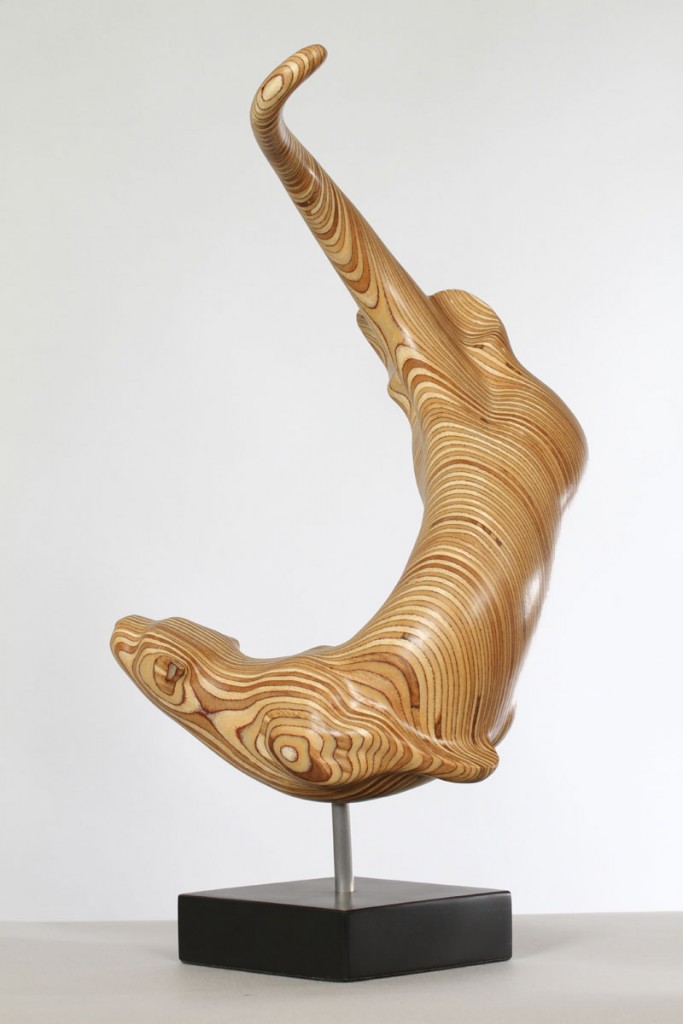
Bill also carves in laminated (layered) hardwoods. He uses high quality birch plywood, which he cuts into rough shapes (to a template he has previously designed) and these shapes are then glued together in layers. Plywood is a beautiful medium and is becoming popular with modern designers and artists.
The lamination method has several advantages. It means sculptures of any size can be carved (they are not limited by the size of wood available from trees), it also gives the most beautiful grained effect, which when they are sanded to a fine finish, oiled and waxed, give a lustrous sheen. By glueing many layers together the carving has greater stability, so it doesn’t split in an environment of varying humidity and temperature and can even be placed outside.
For sculptures which are to be placed outside Bill has sourced a finish used for marine situations. This product is transparent and flexible, and moves with the sculpture as it, in turn, expands and contracts slightly with temperature and humidity differences. As with all wood placed outside plywood will need regular maintenance.
Bronzes
Bronzes (which are produced at a foundry) are made by the lost wax method. This method has been used to make bronzes for thousands of years. All bronzes are cast from some form of original or “master”, most usually constructed from clay, plasticine or wax. Bills are often (but not always) made from wood (see above.)
First a mould is taken from the original. Today, this mould is usually made from silicon rubber, which is flexible and easy to use. Previously piece moulds were made from plaster. Molten wax is poured into the mould. The mould is moved and rotated to ensure the wax coats the whole of the inside of the mould evenly. This process is repeated until the required thickness of wax is achieved (this will be the final thickness of the bronze). The wax cast is now removed from the mould. The cast is hollow, as only a thinnish layer was built up in the mould. Wax rods (sprues) and a funnel- like cup are fitted onto the wax cast which will eventually take the poured bronze and allow for release of captured gasses. The sprue system and wax positive are then coated (inside and out) with a ceramic liquid.
The piece, now coated in a ceramic shell, is fired in a kiln. This bakes the shell and melts the wax, which runs out of the mould, leaving a cavity in its place. (Thus the term, “LOST WAX.”) The ceramic shell is removed from the kiln and molten bronze is poured into the mould. This is left to cool and the ceramic shell is cut and chipped away. The cooled bronze is a replica of the wax cast, including the sprues and funnel. These are removed by an artisan. Then by grinding, chasing, sanding and polishing, all areas are blended back to make the bronze look exactly like the artist’s original sculpture. The bronze is now treated with chemicals and heat to give it the chosen patination. The patina is sealed under a wax coating and becomes a permanent part of the sculpture.
